Operation K #3
안녕하세요!
Well… I've considerably slowed down on my Korean learning; my attempts to integrate grammar lessons were not prosperous. Perhaps, trying to cover one lesson every single day—especially HTSK lesson—was not a very good idea.
I still think that comprehensible input is the core engine of learning a language. But I presume strong foundational grammatical knowledge weighs more when you are a beginner. It's often better to just read the technical rules underlying a certain particle, word, or structure rather than trying to guess how it works from the context. For instance, I don't think I could've properly understood irregulars without reading the explanations (although I still have some troubles with them even after the lesson).
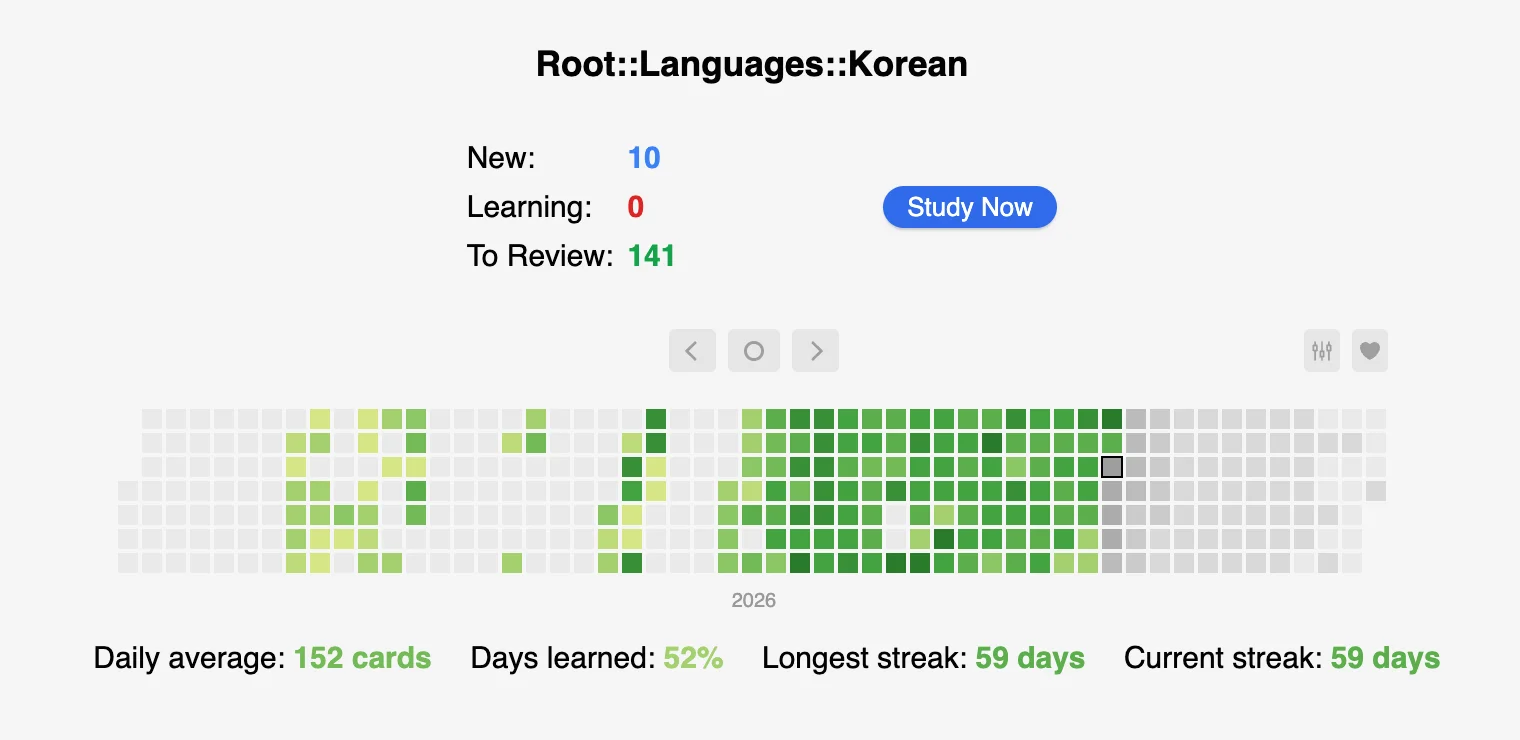
But I'm pretty happy with my Anki streak! I've been reviewing the cards for almost 2 months without any skips and so far I have ~450 mature cards.
But I can't make something sensible from these words without knowing some grammar, so I'm back on grammar. I decided to start smaller by covering only two HTSK lessons per week. We'll see how it goes.
Word of the week
I decided to play around with the format of Operation K and Claude suggested the "word of the week" idea!
This week's word is 푸르다 which is the dictionary form of the verb "to be blue/green". It's a pretty unique word that, as far as I can tell, doesn't have any commonly used alternatives in English, Russian, or Kazakh.
The word is used as blue in 푸른 하늘 (blue sky); as green in 푸른 숲 (green forest); as blue in 푸른 바다 (blue sea). So, generally, it's used as a color that you can observe in nature.
Then I've looked up on this topic and turns out it relates to a concept of grue which isn't unique to Korean; Chinese, Japanese, Vietnamese, and many other languages seem to have similar words.